

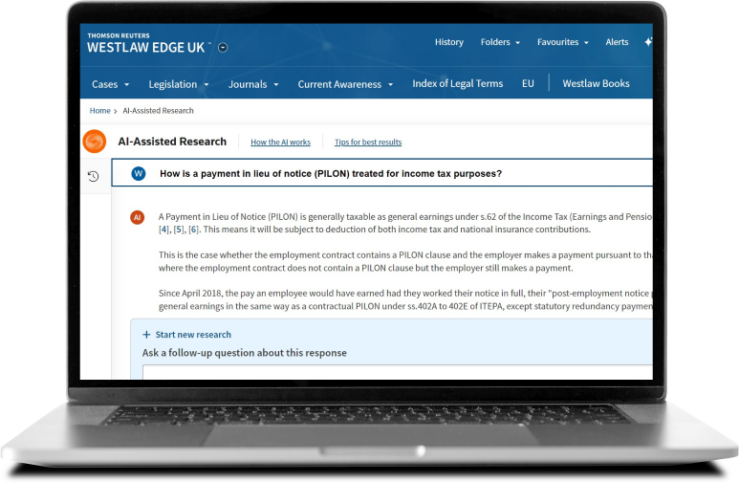
Thomson Reuters is expanding customers’ access to AI-Assisted Research with the introduction of Westlaw Edge UK with CoCounsel. The first Thomson Reuters generative AI legal research offering in the UK, Westlaw Edge UK with CoCounsel streamlines the initial phase of legal research by allowing customers to ask complex questions in natural language and delivering synthesized …
Information and commentary on the business and practice of law at Thomson Reuters.
Articles
Tech and Legal Industries React to the Thomson Reuters Expansion of CoCounsel
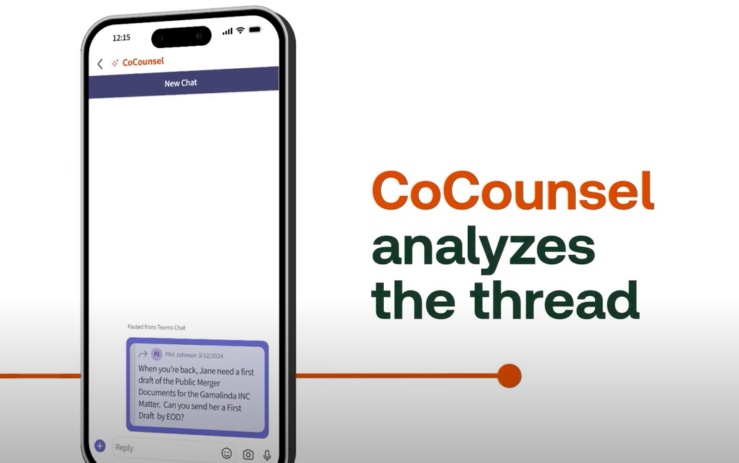
The Thomson Reuters expansion of CoCounsel “spreads the LLM love beyond legal,” said Richard Tromans on social media as part of Artificial Lawyer’s coverage of the announcement. Journalists and bloggers shared their perspectives on the CoCounsel expansion, which includes the rollout of the generative AI assistant beyond the legal landscape as well as new skills …
Thomson Reuters Announces Expanded Vision for Delivering Generative AI Assistant
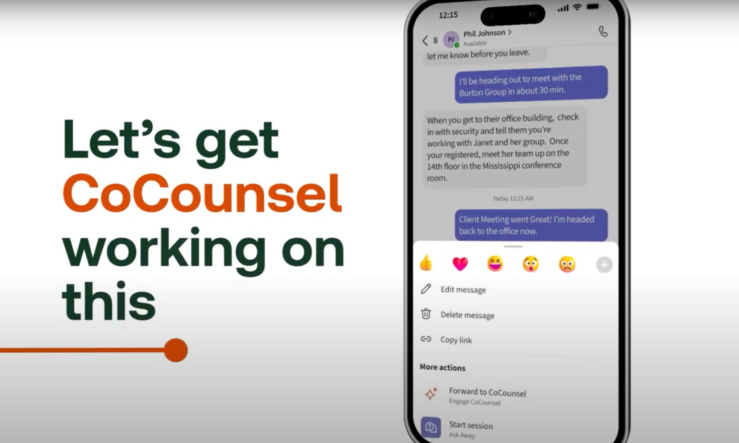
Thomson Reuters is sharing its expanded vision for CoCounsel, its generative AI (GenAI) assistant. The CoCounsel expansion will unify the customer experience and give customers a new way to access Thomson Reuters product capabilities with applications across legal, tax, risk & fraud, and media segments. CoCounsel can handle complex tasks with natural language understanding, providing …

Seeking Nominations for the 2024 William L. Norton, Jr. Judicial Excellence Award
The nomination period is open for the 2024 William L. Norton, Jr. Judicial Excellence Award. This collaboration between the American Bankruptcy Institute (ABI) and Thomson Reuters recognizes distinguished bankruptcy judges for their service to the insolvency community. The award was created to honor the late bankruptcy judge and longtime West author William L. Norton, Jr. This year …

Podcast Highlights: Emily Colbert on the Human Side of Generative AI
Emily Colbert, senior vice president of product management at Thomson Reuters, joined Dennis Kennedy and Tom Mighell on the Kennedy Mighell Report to talk about how legal professionals are using AI. They discussed the integration of generative AI into Practical Law, which Colbert emphasized required extensive human expertise. They also talked about driving efficiencies and …

Podcast Highlights: Pablo Arredondo on the Legal Profession’s “Fervor and Excitement” Around Generative AI
Pablo Arredondo, vice president of CoCounsel at Thomson Reuters and co-founder of Casetext, has been making the rounds on legal tech and AI podcasts, celebrating the one-year anniversary of CoCounsel. Legal Current shares highlights from his conversations on 3 Geeks and a Law Blog and The Cognitive Revolution. Arredondo talked with The Cognitive Revolution’s Nathan …

State of Canada Reports Reveal Successes, Disconnects For Lawyers Confronting Challenges
Canadian lawyers – in law firms and government legal agencies – are faring well despite continuing to confront challenges including spending too much time on administrative tasks, managing rate pressures, and improving mental health. These are among the takeaways from the State of the Canadian Law Firm Market and the Canadian Government Lawyers Benchmark reports, …

International Women’s Day: Kriti Sharma Calls for More Women Working in AI, LegalTech
Thomson Reuters Chief Product Officer of LegalTech Kriti Sharma is asking how the legal industry can better support women pursuing careers and opportunities around AI. In honor of International Women’s Day, Sharma discusses on LinkedIn the need for more female role models in the tech sector as AI opens up traditional career pathways and creates …

Podcast Highlights: Jake Heller Talks with Mosheh Poltorak on AI’s Impact in the Legal Space
Jake Heller, head of Product, CoCounsel, for Thomson Reuters recently joined Mosheh Poltorak to talk about the evolution of Casetext and how AI is transforming the legal landscape. Legal Current listened to their conversation to share highlights from the Product Market Fit podcast. Their discussion kicked off with a look at how Casetext grew from …

Podcast Highlights: Mike Dahn and Joel Hron Talk AI Strategy with Bob Ambrogi
Mike Dahn, head of Westlaw Product Management for Thomson Reuters, and Joel Hron, head of AI and Thomson Reuters Labs, recently joined Bob Ambrogi for a conversation on the company’s generative AI strategy. Legal Current listened in to share highlights from their podcast. They started with the impact of last year’s launch of AI-Assisted Research …
